Course description

Clinical Data Management (CDM) is one of the most in-demand yet least formally taught functions in the pharmaceutical industry. Every drug that reaches a patient depends on the quality of its clinical trial data — and CDM professionals are the guardians of that quality.


This program is built specifically for pharma graduates who want to transition into CDM roles at pharmaceutical companies, CROs (Contract Research Organisations), and biotech firms. Whether you are a fresh graduate in pharmacy, life sciences, or biotechnology, or an early-career professional looking to specialise, this program gives you the structured, practical knowledge that employers actually hire for.


WHAT YOU WILL LEARN:


You will journey through all five phases of drug development — Discovery, Preclinical, Clinical Trials (Phases I–III), Regulatory Submission, and Post-Marketing — and understand exactly what CDM professionals do at each stage. You will learn how to design Case Report Forms (CRFs), manage an Electronic Data Capture (EDC) system, write and interpret a Data Management Plan (DMP), execute query management, perform medical coding using MedDRA and WHO Drug Dictionary, and prepare a database for lock.


You will also master the regulatory landscape: ICH E6(R2) Good Clinical Practice, 21 CFR Part 11, CDISC standards (CDASH, SDTM, ADaM), and how SDTM datasets are prepared for FDA and EMA submissions. By the end, you will understand the full lifecycle of clinical data — from the moment a patient visits a trial site to the moment a regulatory agency approves a drug.


WHY THIS PROGRAM:


✔ Written by a CDM and clinical research professional with hands-on pharma industry experience

✔ Covers all five drug development phases — not just the clinical trial phase

✔ Includes real-world scenarios from actual trial situations

✔ Each chapter includes knowledge checks and interview Q&A

✔ Immediately applicable — the skills in this program are used on Day 1 of a CDM role

✔ Aligned with industry standards: ICH, CDISC, FDA, EMA, GCP


WHO THIS IS FOR:


This program is ideal for pharmacy graduates, life sciences graduates, biotechnology graduates, and early-career professionals in clinical research, medical affairs, or regulatory affairs who want to build a formal, structured career in Clinical Data Management.


No prior CDM experience is required. A basic understanding of the pharmaceutical industry or clinical research is helpful but not mandatory — the program begins from first principles.

What will i learn?

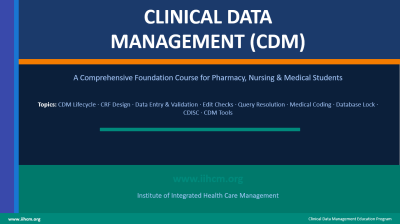
  • Explain all 5 phases of drug development and describe the specific CDM activities and deliverables at each stage
  • Write and interpret a Data Management Plan (DMP) — the master governing document for clinical trial data
  • Design and interpret edit checks (validation rules) for range, consistency, and completeness errors in clinical data
  • Perform medical coding using MedDRA (adverse events) and WHO Drug Dictionary (medications)
  • Apply CDISC standards: understand CDASH, map CRF data to SDTM domains, and interpret ADaM dataset structures
  • Apply CDISC standards: understand CDASH, map CRF data to SDTM domains, and interpret ADaM dataset structures
  • Design a well-structured Case Report Form (CRF) that aligns with protocol requirements and CDASH standards
  • Navigate and operate Electronic Data Capture (EDC) systems including Medidata Rave and Oracle Clinical
  • Manage the complete query lifecycle — from auto-query generation to site response, resolution, and SLA tracking
  • Manage the complete query lifecycle — from auto-query generation to site response, resolution, and SLA tracking
  • Lead a database lock process — completing the pre-lock checklist and coordinating across CDM, biostatistics, and medical teams
  • Describe post-marketing CDM activities including Phase IV trials, PSUR reports, and Risk Management Plans

Requirements

  • Education: Bachelor's degree or diploma in Pharmacy, Life Sciences, Biotechnology, Microbiology, Biochemistry, Nursing, or a related health science field
  • Technical skills: Comfortable using a computer and basic Microsoft Office tools (Word, Excel). No programming or database experience required
  • Attitude: Strong attention to detail and a methodical approach to learning — CDM is a precision profession where accuracy is paramount
  • Industry knowledge: Basic familiarity with the pharmaceutical industry or clinical research is helpful but not mandatory — the program is designed to start from first principles
  • Device: A laptop or desktop computer with internet access to explore EDC system demos and regulatory resources referenced in the program

Frequently asked question

No — this program is designed specifically for pharma graduates with no prior CDM experience. It starts from the fundamentals of drug development and builds up systematically. If you have a degree in pharmacy, life sciences, or biotechnology, you have all the background needed.

Yes. The program is structured around what employers actually look for in entry-level CDM roles. It covers the tools, standards, and workflows used daily in CROs and pharmaceutical companies. The Career Toolkit chapter includes job role breakdowns, certification guidance, and 15+ real interview questions with model answers.

The program covers the industry's most widely used EDC systems: Medidata Rave (Veeva Vault EDC), Oracle Clinical, and REDCap. It also covers CDISC standards (CDASH, SDTM, ADaM), medical coding dictionaries (MedDRA, WHO Drug Dictionary), and the regulatory frameworks (ICH E6, 21 CFR Part 11, FDA, EMA).

The content is globally applicable. All regulatory standards (ICH, CDISC, FDA, EMA) and EDC systems covered are used worldwide. CRO and pharma companies in India, the USA, Europe, and Asia all use the same tools and standards taught in this program.

The program is self-paced. Most learners complete it in 4–8 weeks studying 1–2 hours per day. Each chapter includes reading content, real-world scenarios, and a knowledge check, so depth of learning varies by individual pace.

Yes — the content aligns with the CCDM (Certified Clinical Data Manager) exam body of knowledge published by the Society for Clinical Data Management (SCDM). Completing this program provides a strong foundation before pursuing formal CCDM certification.

Yes, a certificate of completion is issued upon finishing all modules and passing the knowledge checks. This certificate can be added to your LinkedIn profile and resume to demonstrate your CDM foundation to employers.

The primary employers are CROs (Contract Research Organisations) such as IQVIA, Covance (Labcorp), Parexel, and PRA Health Sciences; pharmaceutical and biotech companies; and academic medical centres running sponsored trials. India is a major hub for CRO operations, making this an especially strong career path for Indian pharma graduates.

Typical progression: Data Entry Associate → Clinical Data Coordinator → Clinical Data Manager → Senior/Lead Data Manager → CDM Director. With 5–8 years of experience and certifications, CDM professionals command strong salaries and are in demand globally.

Yes — you will have lifetime access to all program materials, including any future updates. Clinical data standards evolve (e.g., new MedDRA versions, updated ICH guidelines), and the content will be updated to reflect these changes.

Dr. Shyam Sunder

₹10000

Lectures

0

Skill level

Intermediate

Expiry period

2 Months

Share this course

Related courses