Course description

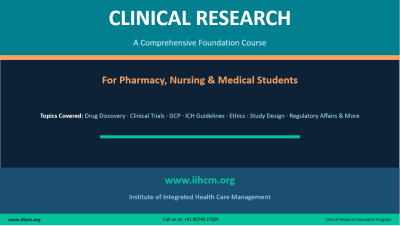
The Clinical Research Foundation Program offered by the Institute of Integrated Health Care Management (IIHCM — www.iihcm.org) is a comprehensive, structured course designed specifically for pharmacy, nursing, and medical students seeking a solid grounding in clinical research and drug development.

What you will study: The program begins with the end-to-end journey of new drug discovery — from target identification and preclinical animal research (in-vitro, ex-vivo, and in-vivo studies) to IND filing and full clinical development. You will explore the classification of clinical research, types of clinical trials (preventive, screening, and treatment), and the five phases of clinical research (Phase 0 through Phase IV).

Regulatory science is a major pillar of this program. Students gain a thorough understanding of CTD modules, regulatory dossiers (INDA/IMPD, NDA/MAA, ANDA, and BLA), the drug approval process, ICH guidelines (Quality, Safety, Efficacy, and Multidisciplinary), and Good Clinical Practice principles as defined in ICH E6 (GCP Principles 1–13).

The program covers ethical foundations — the Nuremberg Code, Declaration of Helsinki, Belmont Report, CIOMS guidelines, and the Common Rule — alongside practical trial management skills including study design (RCT, crossover, single-arm, cohort, case-control), blinding techniques, placebo use, bias prevention, clinical study protocols, and clinical study reports.

Students also learn about the complete trial master file (TMF/eTMF), key stakeholder responsibilities (Sponsor, Investigator, CRA, CRC, IRB/IEC), informed consent processes, case report forms, epidemiology fundamentals (incidence, prevalence, epidemic, endemic, pandemic), and the essential terminology used across the clinical research industry.

The program covers emerging trial models including centralized, decentralized, and hybrid trials, and introduces participants to both centralized and site-level trial operations.

Who this is for: Final-year and postgraduate students in pharmacy (B.Pharm, M.Pharm, Pharm.D), nursing (B.Sc Nursing, M.Sc Nursing), medicine (MBBS, MD), and allied health sciences who wish to enter the clinical research, regulatory affairs, or pharmaceutical industry.

Delivery: Structured, slide-based self-paced learning program with 23 professionally designed modules. Offered by IIHCM as part of its Health Care Management education portfolio.

What will i learn?

  • ✓ Explain the complete new drug discovery and development process from preclinical to post-marketing surveillance
  • ✓ Distinguish between Phase 0, I, II, III, and IV clinical trials and describe the purpose and typical sample size of each phase
  • ✓ Interpret and prepare regulatory dossiers including INDA/IMPD, NDA/MAA, ANDA, and BLA using CTD module structure
  • ✓ Apply ICH E6 GCP principles and identify the responsibilities of Sponsors, Investigators, CRAs, CRCs, and IRB/IEC members
  • ✓ Evaluate clinical trial study designs including RCTs (parallel and crossover), observational designs, and decentralized trial models
  • ✓ Describe ethical frameworks — Nuremberg Code, Declaration of Helsinki, Belmont Report, CIOMS, and the Common Rule — and apply them to trial scenarios
  • ✓ Understand blinding techniques (single, double, triple-blind), allocation concealment, dummy techniques, placebo use, and sources of bias
  • ✓ Correctly use and explain 60+ essential clinical research terminologies used in the pharmaceutical and CRO industry
  • ✓ Describe the components and purpose of Trial Master Files (TMF/eTMF), Informed Consent Forms (ICF), and Case Report Forms (CRF)
  • ✓ Apply epidemiological concepts — incidence, prevalence, epidemic, endemic, and pandemic — to understand public health and clinical research context
  • ✓ Demonstrate readiness for entry-level roles in clinical research, regulatory affairs, pharmacovigilance, and the pharmaceutical industry

Requirements

  • Academic eligibility: Students enrolled in or graduates of B.Pharm, M.Pharm, or Pharm.D programs B.Sc Nursing, M.Sc Nursing, or Post Basic Nursing students and graduates MBBS, MD, BDS, or allied health science students Life sciences graduates (Biochemistry, Biotechnology, Microbiology, Zoology) Healthcare professionals seeking a formal clinical research foundation
  • Prerequisites & technical needs: Basic understanding of human anatomy, physiology, and pharmacology Proficiency in English (reading and comprehension level) No prior clinical research experience required — beginner-friendly Device with PDF/presentation viewer (laptop, tablet, or desktop recommended) Willingness to engage with regulatory documents, guidelines, and scientific terminology

Frequently asked question

This program is designed for pharmacy (B.Pharm, M.Pharm, Pharm.D), nursing (B.Sc, M.Sc Nursing), and medical students (MBBS, MD), as well as graduates from life sciences disciplines who wish to build a strong foundational knowledge of clinical research, drug development, and regulatory affairs.

No prior experience is required. The program is structured as a beginner-to-intermediate foundation course. It starts from the basics of drug discovery and progressively covers advanced topics like regulatory submissions, GCP, and study designs in a learner-friendly manner.

The program covers New Drug Discovery, Preclinical Research, Clinical Trial Classifications, Phases 0–IV, CTD Modules and Regulatory Dossiers (INDA, NDA, ANDA, BLA), Drug Approval Process, ICH Guidelines, GCP Principles (ICH E6), Ethical Principles, Trial Conduct, TMF/eTMF, Study Designs, Blinding, Placebo, Bias, CSP, CSR, Centralized/Decentralized Trials, Stakeholder Responsibilities, ICF, CRF, CFR, Epidemiology, and Key Terminologies.

Yes. The program is fully aligned with ICH E6(R2) GCP Guidelines, ICH Q, S, E, and M series guidelines, FDA 21 CFR regulations, EMA GVP modules, CDSCO (India) Schedule Y, and WHO guidelines. Content reflects the current global regulatory landscape.

Graduates are prepared for entry-level roles including Clinical Research Associate (CRA), Clinical Research Coordinator (CRC), Regulatory Affairs Executive, Clinical Data Manager, Pharmacovigilance Associate, Medical Writer, and Site Management Associate across pharmaceutical companies, CROs, hospitals, and regulatory agencies.

The program consists of 23 structured, slide-based learning modules. Each module covers a specific topic with definitions, key concepts, regulatory references, and practical examples. The program is delivered in a self-paced format and is offered by IIHCM (www.iihcm.org).

Yes. The program includes coverage of CDSCO (Central Drugs Standard Control Organisation), Schedule Y of the Drugs and Cosmetics Act, the Indian regulatory submission process, CDSCO's role in clinical trial approval, and alignment with global ICH standards as applied in India.

A Clinical Research Associate (CRA), also called a monitor, is employed by the sponsor or CRO and conducts site visits to verify protocol compliance and data integrity. A Clinical Research Coordinator (CRC) is site-based, manages day-to-day trial operations, coordinates patient visits, completes CRFs, and liaises with the CRA. Both roles are covered in detail in this program.

Yes. The program dedicates a full module to GCP Principles 1 through 13 as defined in ICH E6(R2), covering ethical conduct, subject rights, scientific standards, informed consent, data integrity, investigational product handling, and quality system requirements.

Yes. You will receive a certificate upon completion.

Dr. Shyam Sunder

₹5000

Lectures

1

Skill level

Advanced

Expiry period

1 Months

Share this course

Related courses